
 Laetitia DJOUEPOU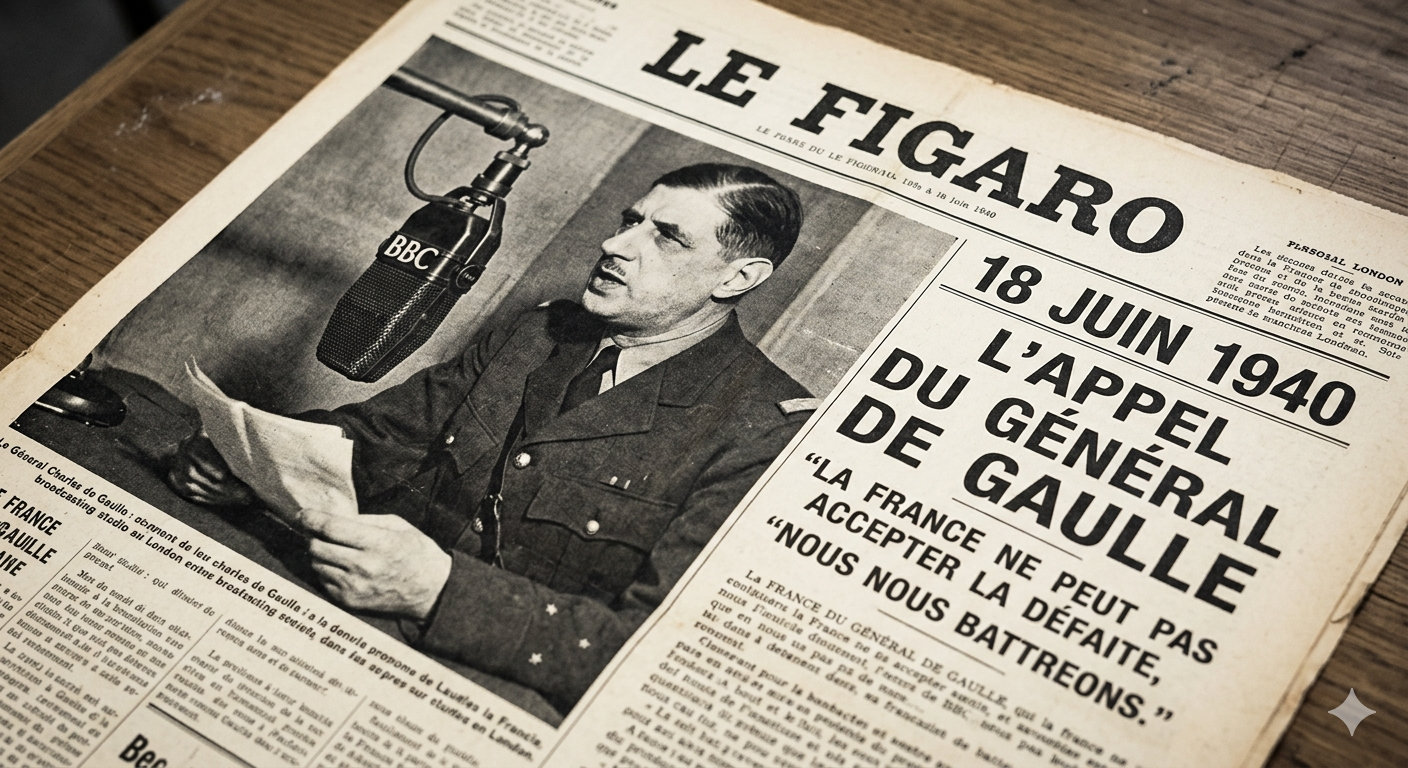
The Spark from the Shadows: How London Became the Heart of French Honor
For French citizens, francophones, and francophiles living across the United Kingdom, the streets of London, the banks of the Thames, and the brick facade of the BBC’s Broadcasting House hold a profound, shared resonance. They are more than just landmarks of our adopted home; they are the literal foundations of modern French liberty.
On June 18, 1940, an obscure, towering French brigadier general named Charles de Gaulle walked into a recording studio in central London. At 10:00 PM British Summer Time, his voice rippled across the English Channel via the airwaves of the BBC. It was a four-minute address that directly challenged the official French government’s capitulation to Nazi Germany.
L’Appel du 18 juin (The Appeal of June 18) did not just spark the French Resistance—it fundamentally preserved the soul and legitimacy of the French Republic. For those of us navigating life between British reality and French identity, understanding this critical moment in history highlights the deep, historic bonds that link France and the United Kingdom.
1. The Cataclysm of June 1940: France on the Brink
To understand the sheer audacity of de Gaulle’s broadcast, we must first look at the utter collapse that preceded it. In May 1940, the German Wehrmacht launched its western offensive. Utilizing highly coordinated tank movements and air support—the devastating strategy known as Blitzkrieg—German forces rapidly bypassed the heavily fortified Maginot Line by pushing through the dense Ardennes forest.
The French army, widely considered one of the most powerful in the world at the time, was systematically outmaneuvered and overwhelmed. Within weeks, millions of civilians fled their homes in the North, clogging roads in a mass panic known as l’Éxode (the Exodus). Paris fell on June 14, and the French government retreated south to Bordeaux, deeply fractured and paralyzed by despair.
The Clash of Two Paradigms: Pétain vs. de Gaulle
Inside the temporary French capital at Bordeaux, a fierce ideological battle erupted. On one side stood Marshal Philippe Pétain, an 84-year-old military icon and the revered “Hero of Verdun” from the First World War. Pétain believed that France was decisively beaten and that its only path to survival lay in total submission. On June 16, the French Prime Minister Paul Reynaud resigned in protest after his cabinet rejected a radical proposal for a Franco-British Union. Pétain immediately took power and, on June 17, addressed the nation with a crumbling resolve, telling the country that it was time to stop the fight.
For Pétain, the war was over. He announced that he had contacted the German leadership to request an armistice, framing capitulation as a painful but necessary act of grandfatherly protection.
But Charles de Gaulle, recently appointed as the Under-Secretary of State for National Defense, saw things with striking clarity. He recognized that Pétain’s path would strip France of its honor and transform it into a vassal state of the Nazi regime. De Gaulle realized that if France was to stay in the war, it could no longer be done from French soil.
On the morning of June 17, under the pretext of an official diplomatic mission, de Gaulle boarded a small British aircraft provided by Winston Churchill. Escaped and effectively exiled, he landed at Heston Aerodrome in west London with little more than a single suitcase, a few thousand francs, and a handwritten draft of a speech.
2. The Battle for the Airwaves in London
When de Gaulle arrived in London, his political standing was precarious. He was not a world leader or a household name; he was a junior general who had briefly served in a fallen cabinet. Furthermore, the British government itself was deeply divided on how to handle him.
Winston Churchill instinctively recognized de Gaulle’s resolve and saw him as a vital asset to keep the flame of French alliance alive. However, members of Churchill’s own War Cabinet, including Foreign Secretary Lord Halifax, were highly hesitant. They worried that broadcasting a rebel French general from London would infuriate Pétain’s new government in Bordeaux, potentially pushing the powerful French navy directly into German hands.
Despite these intense diplomatic negotiations, Churchill ultimately pushed through the permission. On the afternoon of June 18, de Gaulle was escorted to the BBC studios at Broadcasting House. He adjusted his uniform, sat before the heavy microphone, and began reading the words that would alter the course of the war.
3. Deconstructing the Speech: A Masterclass in Strategy
The text of L’Appel du 18 juin is an exceptional piece of political rhetoric and strategic foresight. In just a few paragraphs, de Gaulle systematically dismantled the defeatist logic of the Vichy regime and offered an alternative path forward based on clear-eyed realism.
Acknowledging the Mechanical Defeat
De Gaulle did not deny the severity of the disaster on the continent. He began by addressing the root cause of the military collapse directly, noting that French forces had been subdued by the mechanical, ground, and air forces of the enemy.
By attributing the defeat to specific tactical elements—tanks, airplanes, and modern strategy—de Gaulle neatly separated the tactical failures of the leadership from the intrinsic honor and capability of the French people. It was a vital distinction that helped restore national self-respect.
The Global Dimension of the Conflict
Pétain and his supporters viewed the battle through a narrow, localized lens, believing that England would soon fall and that a prompt surrender would secure France a better seat at the peace table. De Gaulle looked further ahead. He reminded his listeners that France was not fighting alone, emphasizing that France had a vast Empire behind her and could align with the British Empire, which held the seas and continued the fight.
This insight was revolutionary for its time. De Gaulle correctly anticipated that the conflict would evolve into a massive global war of attrition, drawing in the industrial might of the United States. He understood that the side with the greater industrial capacity and global depth would ultimately prevail.
The Decisive Declaration
De Gaulle concluded his speech with a historic call to arms, establishing himself as the custodian of a free and fighting France. He explicitly invited all French servicemen, engineers, and workers who were on British territory, or who could get there, to join him in London, declaring that whatever happened, the flame of French resistance must not and would not be extinguished.
4. The Myth vs. The Reality: Who Actually Heard It?
In contemporary French history, June 18 is celebrated as the foundational moment of the Resistance. However, a closer look at historical records reveals a surprising paradox: almost nobody in France actually heard the broadcast on June 18.
Because the speech was arranged quickly and broadcast with very little advance notice on a foreign radio frequency, the vast majority of French households were either tuned out or completely unaware of it. Furthermore, the BBC did not record the live broadcast that evening; the audio archives we listen to today are actually recordings of his second, more widely heard speech on June 22, 1940, delivered after the formal signing of the Franco-German armistice.
In the immediate aftermath of the speech, only a small number of volunteers rallied to de Gaulle’s side in London. Of the tens of thousands of French soldiers evacuated during the Dunkirk operations who were still on British soil, the vast majority chose to return home to their families rather than join an unknown rebel officer. By the end of July 1940, de Gaulle’s Forces Françaises Libres (Free French Forces) numbered only around 7,000 personnel.
Yet, the actual size of the initial audience did not diminish the speech’s long-term impact. The text was quickly printed in British newspapers like The Times and transcribed onto leaflets that were dropped over France by the Royal Air Force. Later that summer, de Gaulle’s message was reinforced by the famous posters plastered across London, which reminded the world that while France had lost a battle, it had not lost the war.
Over time, the Appeal of June 18 transformed from a simple radio broadcast into a powerful national myth—a symbol of moral refusal that grew stronger with each passing month of the occupation.
5. London: The Crucible of Free France
For the expatriate francophone community currently living in the UK, walking through London means retracing the steps of the Free French movement. Between 1940 and 1944, London served as the administrative, political, and emotional capital of a free France.
The Topography of Free France in London
- 4 Carlton Gardens (St. James’s): This elegant building near Pall Mall served as de Gaulle’s official headquarters (Le Quartier Général). It was here that he built a functioning state apparatus from scratch, complete with intelligence services, administrative offices, and a military staff. Today, a bronze statue of the General stands nearby, marking the building as the heart and soul of la France Libre.
- 1 Dorset Square (Marylebone): This address housed the French section of the British Special Operations Executive (SOE). It was the launching pad for secret agents, couriers, and saboteurs who braved night flights to parachute back into occupied France, linking the external resistance in London with internal networks on the ground.
- The Connaught Hotel (Mayfair): De Gaulle lived here for a significant period during the war. It became the site of intense, often difficult midnight strategy sessions between the French leader and his inner circle.
6. The Franco-British Relationship: A Complex Alliance
The story of the Appeal of June 18 is also a profound chapter in the historical relationship between France and Great Britain. The alliance between de Gaulle and Churchill was an extraordinary partnership born of necessity, marked by deep mutual respect, but also filled with intense personal friction.
Churchill was fond of noting the sheer difficulty of managing relations with the unyielding French leader. De Gaulle was fiercely defensive of French sovereignty, constantly worried that the British and Americans would try to relegate France to a secondary role.
Yet, despite their frequent arguments, this Franco-British cooperation proved indispensable. The United Kingdom gave de Gaulle a voice, a secure base, and the vital financial and military backing required to build his forces. In return, de Gaulle provided the Western Allies with invaluable intelligence networks, strategic colonial territories in Africa and the Pacific, and the essential moral legitimacy of a fighting France.
Conclusion: Honoring the Flame in the 21st Century
Eighty-six years after Charles de Gaulle stood before that BBC microphone, his message continues to carry a timeless relevance for the francophone and francophile community living across the United Kingdom.
Living abroad gives us a unique perspective on identity. We appreciate British culture while holding fast to our French heritage. We embody the cross-Channel bridge that Churchill and de Gaulle fought to preserve during Europe’s darkest hour.
The Appeal of June 18 reminds us that courage often begins with a solitary voice willing to stand up for principle when defeat seems certain. It shows that honor is not a passive sentiment, but a deliberate choice to act. As we walk past Carlton Gardens, catch sight of the BBC, or hear the chimes of Big Ben, let us remember the immense debt we owe to that generation of exiles. They turned their refuge in London into a powerful fortress of liberty, ensuring that the flame of French resistance would never be extinguished.


 Saint-Irenee DJOUEPOU