
 Laetitia DJOUEPOU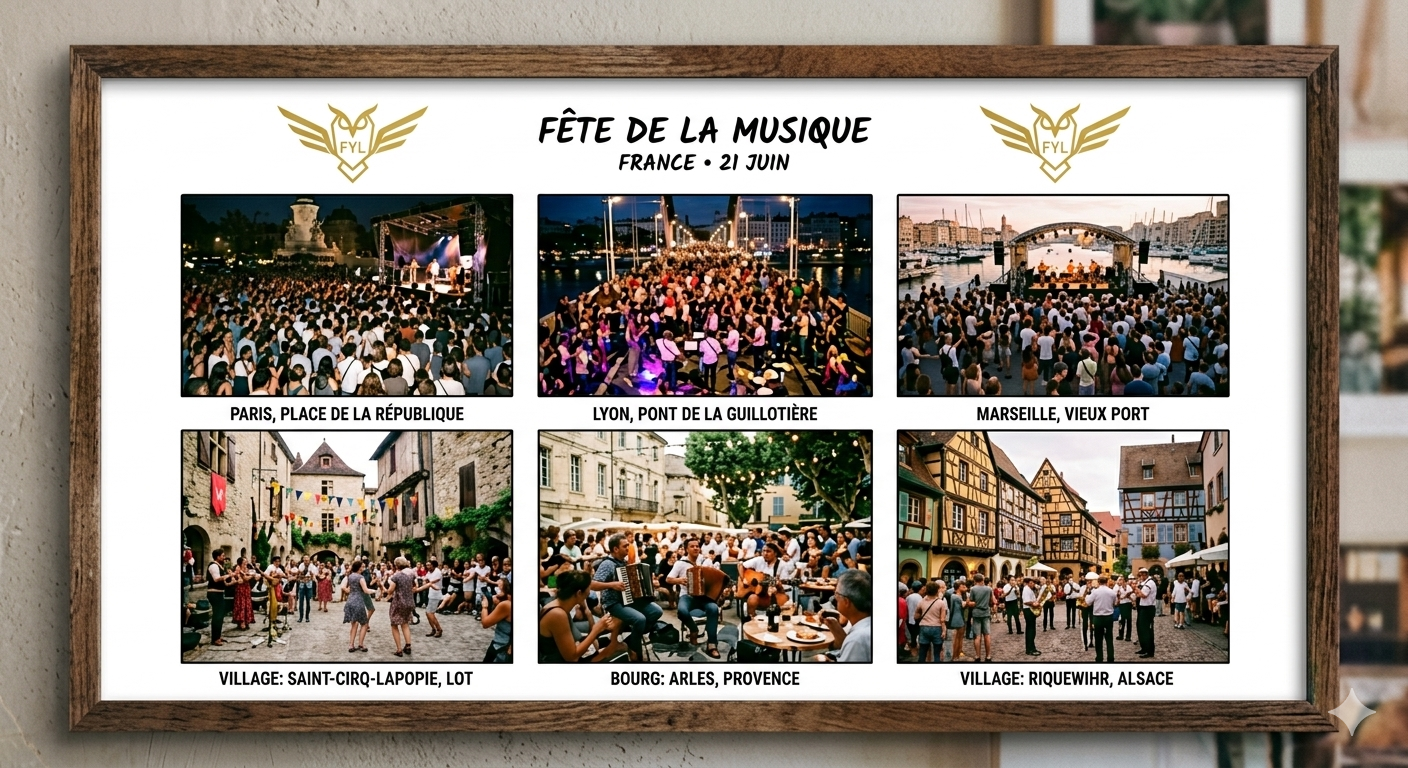
The Sound of Midsummer: Why France’s Fête de la Musique is the Ultimate Cultural Phenomenon (and How to Experience It)
If you find yourself in any French town or city on the evening of the 21st of June, your senses will undergo a profound shift. The familiar hum of evening traffic is replaced by something entirely different.
Step out of a metro station in Paris, or stroll into a medieval square in a quiet village in the Dordogne, and you will walk headfirst into a wall of sound. Around one corner, a four-piece teenage indie band is tearing through a classic rock cover with maximum enthusiasm and slightly questionable tuning. Around the next, an elderly gentleman is coaxing haunting classical melodies from an accordion. Down an alleyway, a towering stack of speakers shakes the ancient timber-framed buildings with deep, hypnotic techno beats, while a few streets over, a full amateur choir performs Vivaldi inside the cool, stone sanctuary of an open-windowed church.
This is not a ticketed music festival. There are no security turnstiles, no wristbands, and no £12 plastic cups of lukewarm beer. This is the Fête de la Musique—a nationwide, completely democratic, wonderfully chaotic explosion of live music that takes over the entire country for one extraordinary night.
For a British audience, accustomed to strict local council noise ordinances, tightly regulated licensing laws, and carefully marshalled public events, the sheer unbridled freedom of the Fête de la Musique can feel like entering a parallel universe. It is a night where the entire concept of public space is reimagined. The streets do not belong to cars; they belong to the people, and more importantly, they belong to the music.
Whether you are planning a summer getaway to France, looking to understand the mechanics of French cultural policy, or simply curious about how an entire nation agrees to stay up until 3:00 AM on a weeknight to listen to music, this is the definitive guide to France’s most vibrant summer tradition.
The Genesis: How an Audacious Idea Revolutionised French Summer
To understand how this musical phenomenon came to be, we have to travel back to the early 1980s—a transformative era for French culture.
The story begins in 1981 with the election of François Mitterrand as President of France. Mitterrand appointed an eccentric, wildly charismatic, and fiercely ambitious man named Jack Lang as his Minister of Culture. Lang did not view culture as something confined to dusty museums, elite opera houses, or high-brow Parisian galleries. He believed culture belonged on the streets, accessible to every single citizen regardless of their social background or bank balance.
In 1982, Lang appointed Maurice Fleuret as the Director of Music and Dance at the Ministry of Culture. Fleuret was a man possessed by a radical vision. He looked at the musical landscape of France and saw a massive disconnect. A ministry study conducted at the time revealed that over five million French people—including one out of every two young people—played a musical instrument. Yet, when you walked down a French street, music was largely invisible, locked away in private living rooms, conservatoires, or expensive concert halls.
Fleuret famously declared a philosophy that would change French society forever:
“The music everywhere and the concert nowhere.”
He wanted to smash the traditional boundaries between the performer and the audience. He didn’t want people to buy tickets to sit in a dark room and politely clap for professionals. He wanted a day where the amateur was king, and the street was the stage.
With incredibly short notice, Lang and Fleuret designated 21 June 1982—the summer solstice, the longest day of the year—as the very first Fête de la Musique. They relied on a clever French play on words as their slogan: “Faites de la musique, Fête de la Musique!” (Make music, celebrate music!).
The Ministry of Culture put out a nationwide call to arms. They urged musicians of all skill levels to take their guitars, violins, drums, and synthesizers out of their homes and pitch up on the streets, in the parks, on the steps of monuments, and outside cafés.
The organizers had no idea if anyone would actually turn up. They feared the initiative might fall entirely flat. Instead, what happened on that warm June night in 1982 surprised everyone. Thousands of musicians flooded the streets of Paris and cities across France. Millions of people stepped outside their front doors to listen, dance, and drink together. It was an instant, overwhelming cultural triumph.
By the following year, the event had solidified into an unmissable national holiday in all but name. What began as a bold, socialist-led experiment in cultural democracy quickly became woven into the very fabric of French national identity.
The Golden Rules: The Mechanics of Chaos
To the outsider, the Fête de la Musique looks like a beautifully orchestrated riot. However, it functions so smoothly year after year because it operates under a strict, unshakeable set of foundational principles that have remained unchanged for over four decades.
Total Gratuitousness (Everything is Free)
The first and most important rule of the Fête de la Musique is that every single performance must be absolutely free to the public. There are no exceptions. No one can charge admission for a street corner, a park bench, or a municipal courtyard. Even when major international rock stars or world-class symphony orchestras participate in official events organized by the Ministry of Culture, the public does not pay a single cent.
Furthermore, the musicians themselves perform for free. Whether you are an amateur teenager playing your first gig or a seasoned professional, you do so for the pure joy of the performance and the communal celebration of the art form.
The Democratisation of Space
On 21 June, the usual bureaucratic red tape that governs public spaces in France vanishes. Under normal circumstances, busking or setting up an amplified sound system on a French street requires complex permits, insurance, and police authorization.
On the night of the Fête, the public domain is entirely liberated. Anyone has the legal right to set up their instruments anywhere they please, provided they don’t block emergency vehicles or create a genuine safety hazard. Sidewalks, public squares, bridges, museum courtyards, hospital gardens, and steps of government buildings are all fair game.
The Suspension of Noise Ordinances
For anyone who has ever had a neighbor call the council because a garden party went past 11:00 PM, this rule will sound like science fiction. On the Fête de la Musique, normal noise restriction laws are officially relaxed.
Bars, restaurants, and cafés are granted special dispensations to stay open much later into the early morning hours, and they are actively encouraged to set up massive external sound systems on the pavement outside their establishments. While the French prefectures and police still reserve the right to intervene if a situation becomes genuinely unsafe, there is an unwritten national contract: for one night, the country agrees to tolerate the noise.
Egalitarianism of Genre
The Fête makes no distinction between “high art” and “popular culture.” A professional brass quintet playing Bach is given the exact same cultural weight and space as a grime artist spitting bars over a backing track or a heavy metal band thrashing out a set in a car park. The festival belongs to all music, providing an incredible cross-section of global sounds.
The Sensory Experience: What It Actually Feels Like
To truly appreciate the Fête de la Musique, one must understand how it transforms the sensory environment of France. It is an event that is felt as much as it is heard.
The day typically begins quite subtly in the late afternoon. Around 4:00 PM or 5:00 PM, as schools finish and offices begin to wind down, you will see the first signs of movement. People walking through the streets carrying guitar cases, dragging amplifiers on small hand carts, or uncoiling endless spools of extension cords from upper-story apartment windows down to the street below.
By 6:00 PM, the soundscape begins to assemble itself. It starts with the sound of tuning up—the crackle of a microphone feedback loop, the sharp thud of a kick drum being tested, the bright strum of an acoustic guitar.
As the sun begins its slow descent on the summer solstice, the heat of the day lingers on the asphalt, and the crowds begin to swell. The atmosphere is distinct from a typical British festival; it is cross-generational. You will see toddlers wearing oversized noise-cancelling headphones sitting on their parents’ shoulders, groups of teenagers huddled together drinking cheap supermarket cider, and elderly couples holding hands as they navigate past a punk rock set.
As you walk through a city like Lyon, Bordeaux, or Paris during the peak hours of 8:00 PM to midnight, the sonic transitions are head-spinning. Because there is no central planning for where amateur musicians can stand, you get incredible, surreal overlaps of sound:
- You might be standing in a crowd of 300 people dancing furiously to a heavy roots-reggae sound system set up outside a kebab shop.
- Walk 50 yards down the street, and the reggae bass fades away, replaced by the crisp, clear acoustic tones of a traditional Breton folk group playing bagpipes and accordions.
- Turn into a hidden stone courtyard, and you are suddenly enveloped in the quiet, reverent silence of a crowd listening to a solo pianist playing Chopin nocturnes on a grand piano that has been painstakingly wheeled out into the open air.
There is a distinct smell to the night, too. It is a mix of warm asphalt, wood-fired pizzas from overstretched restaurants, the sweet scent of Moroccan mint tea and pastries from street stalls, and the unmistakable aroma of merguez (spicy North African sausages) sizzling on makeshift barbecues set up on the pavements.
If you are planning to travel to France specifically to experience the Fête de la Musique, your experience will vary wildly depending on where you choose to drop anchor. Both Paris and the French provinces offer entirely different, yet equally brilliant, versions of the night.
The Lasting Impact: A Global Legacy
What started as a purely French domestic policy experiment in 1982 has since evolved into one of the most successful cultural exports in human history.
In 1985, to coincide with the European Year of Music, France exported the concept to its neighbors. The simplicity and universality of the idea caught fire immediately. Today, the Fête de la Musique has evolved into World Music Day (or Make Music Day in the Anglosphere), celebrated simultaneously on June 21st in over 120 countries and more than 1,000 cities worldwide.
From Berlin to New York, Tokyo to Buenos Aires, and even across various cities in the UK, communities step outside on the summer solstice to play music for free in public spaces.
Yet, while the global iterations are wonderful, there remains something uniquely magical about experiencing it on its home turf in France. It is only in France that the event carries that specific, potent mix of political backing, absolute civic freedom, and historical weight. It is a night where the traditional French values of Liberté, Égalité, Fraternité are given a live soundtrack.
It proves that music is not just entertainment to be consumed behind closed doors or within the secure fences of a commercial festival. Instead, music is a vital, living connective tissue that has the power to turn a city of strangers into a massive, harmonious community, if only for one unforgettable midsummer night.
If you ever have the opportunity to cross the Channel and stand on a French street corner on the 21st of June, take it. Step out into the warm evening air, let the wave of sound wash over you, and join the chorus of the longest day of the year. You will never look at a city street the exact same way again.


 Saint-Irenee DJOUEPOU