
 Saint-Irenee DJOUEPOU
When the workday finally draws to a close, people around the globe naturally seek out ways to unwind, socialise, and transition from professional responsibilities to evening leisure. Two of the most distinct and culturally rich traditions for this transition are the English “Happy Hour” and the French “Apéro” (short for apéritif). While both customs revolve around consuming drinks in the early evening, they represent fundamentally different philosophies regarding food, time, social interaction, and lifestyle.
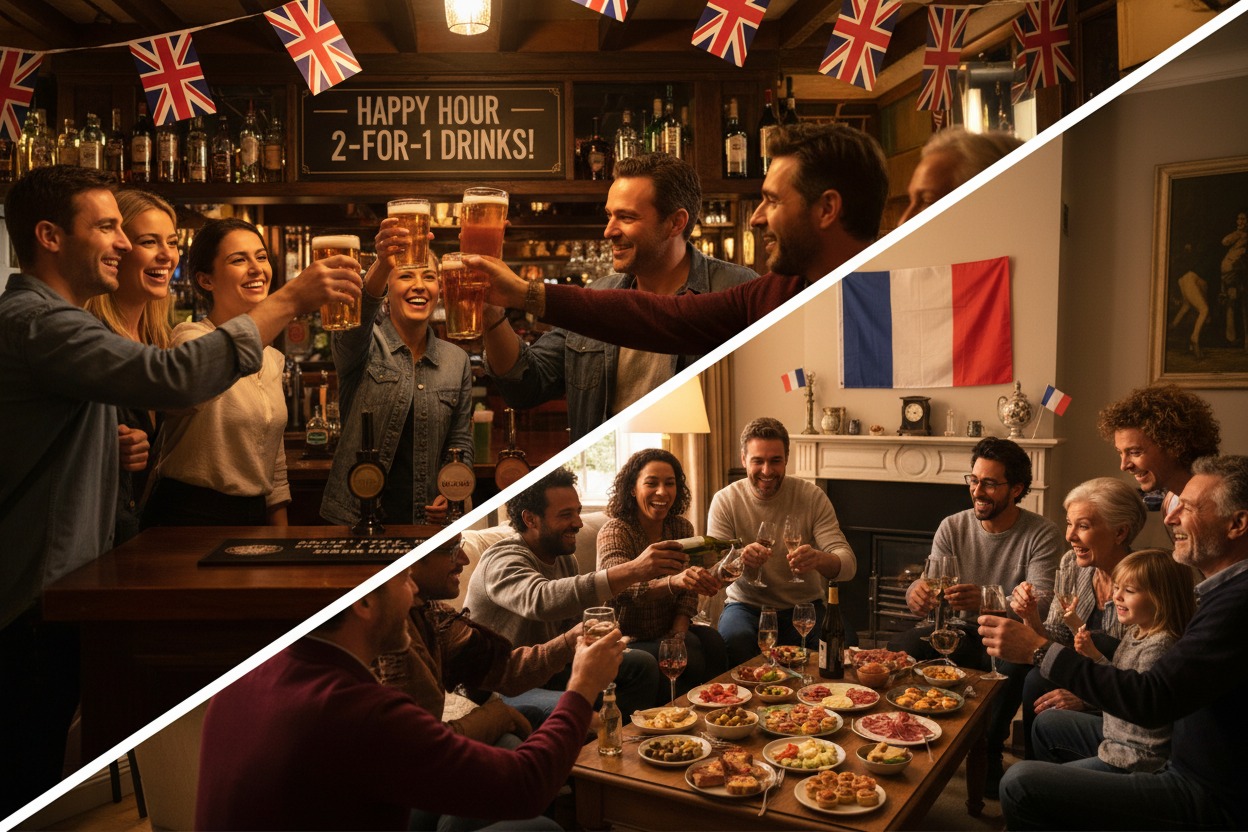
To understand the English Happy Hour, one must look at the traditional British pub culture. Originating primarily as a marketing tool for bars and pubs to attract customers during slow periods—typically between 5 PM and 7 PM—Happy Hour is largely transactional and time-bound. It is defined by discounted alcohol, such as two-for-one cocktails, reduced-price pints of beer, or cheap house wines. The atmosphere is often bustling, loud, and rushed, as patrons try to make the most of the discounted window before standard prices resume.
In England, Happy Hour is frequently associated with after-work office drinking. Colleagues gather hurriedly in crowded pubs, standing room only, balancing a pint in one hand and perhaps a bag of crisps or peanuts in the other. The focus is unequivocally on the beverage rather than gastronomy. It is a quick pit stop before rushing home for dinner, a way to decompress rapidly from the stresses of the corporate world. The social dynamic is casual, transient, and sometimes borders on excessive drinking, fueled by the urgency of the discount clock ticking down.
In stark contrast, the French apéro—or l’apéritif—is not merely a discounted time slot; it is a sacred social institution deeply embedded in the French way of life. Originating from the Latin word aperire, meaning “to open,” the apéro is traditionally designed to stimulate the appetite before a meal. However, in modern France, it has evolved into a standalone ritual of conviviality that can easily stretch for hours, sometimes replacing dinner altogether.
Unlike the loud, crowded English pub during Happy Hour, the French apéro is characterised by a relaxed, unhurried pace. It can take place anywhere: at a neighbourhood café terrace, on a Parisian balcony, in a sunlit park, or gathered in someone’s living room. Time seems to slow down. While drinks are certainly central—ranging from a crisp pastis in the south, a glass of champagne, a chilled rosé, or artisanal craft beers—the apéro places an equal, if not greater, emphasis on food.
An authentic apéro always features grignotages (nibbles). This is not just a bag of crisps, but a carefully curated spread of artisanal cheeses, charcuterie, olives, nuts, radishes with sea salt, and fresh artisanal bread. It is a sensory experience where culinary appreciation meets social bonding.
Ultimately, the difference between the English Happy Hour and the French apéro reflects a broader cultural divide. The English version is functional, economical, and swift—a pragmatic way to end the workday with a bargain. The French version is philosophical, aesthetic, and communal—a celebration of the art of living (l’art de vivre), where the quality of the company and the food matters far more than the price of the drink.