
 Saint-Irenee DJOUEPOU
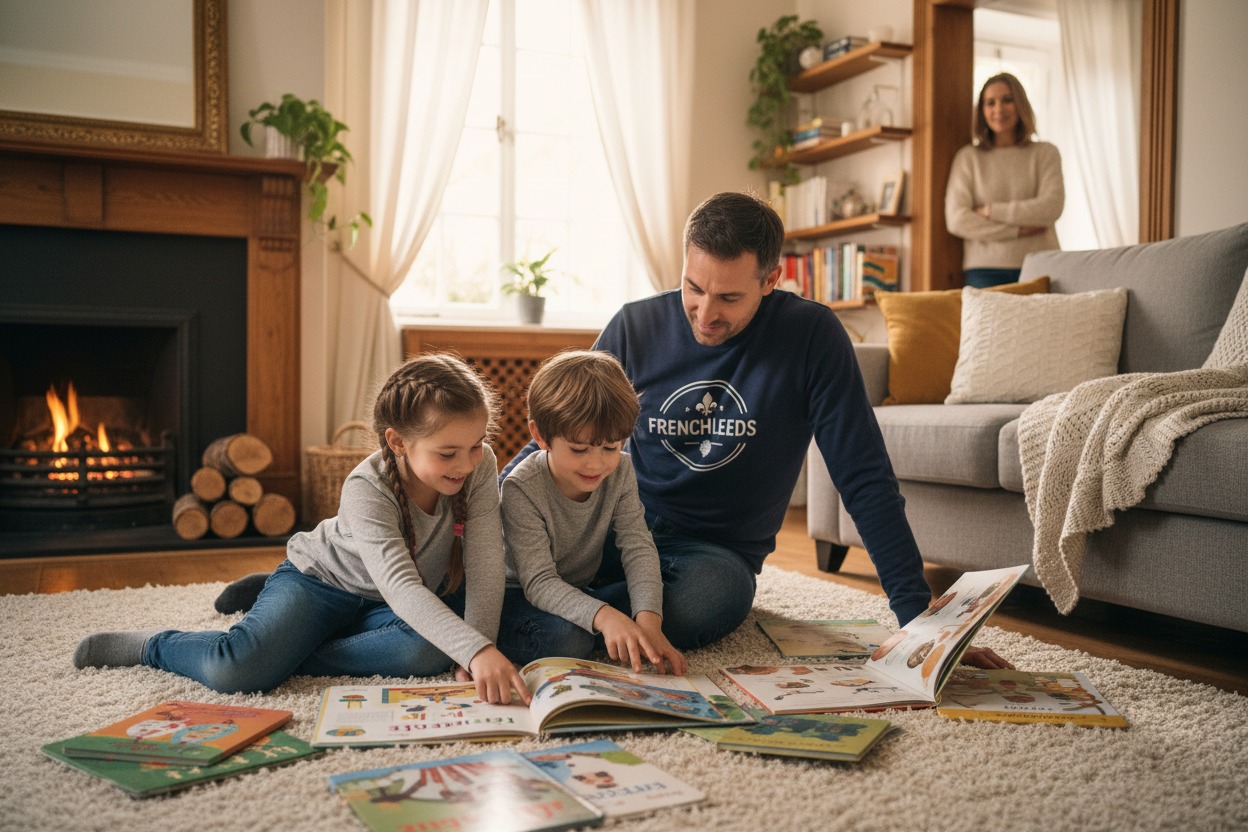
Thomas B. stood in the middle of his living room, staring at a pile of colorful workbooks, an iPad open to a popular gamified language app, and a printed schedule for a weekly online tutor. His two children, Leo, aged eight, and Chloe, aged six, were staring blankly at the screen, more interested in tapping the animated characters than actually repeating the vocabulary words.
“Cat,” Thomas prompted gently.
“Chat,” Chloe replied with a giggle, defaulting to French.
Thomas sighed, running a hand through his hair. As an English engineer who had spent five glorious years living and working in France, where he met his wife, Elodie, he had always dreamed of raising a seamlessly bilingual household. Elodie, who spoke fluent English herself, fully supported the mission. They lived in the UK, making English the dominant language outside their front door. Yet, inside their home, a strange linguistic tug-of-war had been going on for two years.
For twenty-four months, Thomas and Elodie had tried everything. They bought phonics books, subscribed to expensive digital platforms, hired native-speaking tutors for Zoom sessions twice a week, and even labeled household furniture with sticky notes. But nothing seemed to be working. Leo still stumbled over basic sentence structures, and Chloe preferred to speak French whenever she was tired or frustrated.
Thomas began to lose faith. As an engineer, he was hardwired to look for the “right system.” If you input the correct variables, you should get the desired output. But language acquisition wasn’t an equation; it was a human process, and he felt like he was failing as a father and a teacher.
“Maybe they just aren’t wired for it,” Thomas mumbled to Elodie one evening after the kids had gone to bed. “We’ve thrown time, money, and every app on the market at this. Maybe we should just let it go.”
Elodie placed a comforting hand on his shoulder. “We can’t give up, Thomas. But you are exhausting yourself. You treat teaching them like an engineering project. Relax a little.”
Easy for her to say, Thomas thought, though he kept it to himself.
The turning point happened on a rainy Saturday afternoon at the local shopping center. Thomas was nursing a lukewarm coffee near the children’s play area while Elodie ran into a pharmacy. He felt a familiar knot of anxiety in his chest. Monday meant another week of battling homework apps and dreading the online tutor’s polite progress reports that always ended with, “Just needs a bit more engagement.”
“Excuse me, is this seat taken?”
Thomas looked up to see a friendly-looking man with a shopping bag in one hand and a toddler holding onto his coat. Seated nearby was a woman with two slightly older children who were chatting away in fluent, accented English, while occasionally switching to fluent French.
“No, please, go ahead,” Thomas said.
As the families settled, Thomas couldn’t help but overhear the father speaking to his children in French, while the mother replied in English, and the kids bounced effortlessly between the two. It was a mirror image of Thomas’s own household—except for one crucial detail: it was actually working.
Unable to help himself, Thomas leaned over. “Pardon me, but I couldn’t help overhearing. Are you a bilingual family too?”
The father smiled warmly. “Yes, I’m British, my wife is French. We live just outside the town.”
“How do you do it?” Thomas asked, the desperation leaking into his voice before he could stop it. “My wife is French, I’m English. We’ve been trying for two years with apps, books, online tutors—the whole nine yards. Nothing sticks. My kids still freeze up or switch back to French at the first sign of difficulty. What’s your secret? What app are you using?”
The man chuckled, shaking his head. “No secret apps, my friend. In fact, we tried all those too. We wasted a lot of money on subscriptions that the kids got bored of in a week.”
“Then how?” Thomas asked, baffled.
“Consistency and patience,” the mother chimed in, leaning over. “When we started, it was a disaster. Our oldest son refused to speak a word of English outside of school. We had screaming matches over homework. We wanted to quit a hundred times.”
“So, what changed?” Thomas asked, leaning in closer.
“We realized that learning a language isn’t about the tools; it’s about the environment and the mindset,” the father explained. “We stopped treating it like a subject in school. We stopped grading them on apps or forcing them through boring online tutoring sessions when they were already tired from a long school day. Instead, we made it a natural part of our lives, and we just… didn’t stop.”
He went on to share a real example from their own struggles. For over a year, they had implemented a strict “one parent, one language” rule, but combined it with zero pressure. If the children made mistakes, they weren’t corrected harshly; they were simply rephrased naturally. If an app didn’t work, they threw it out. If a tutor was too rigid, they fired them. They replaced screen time with storytelling, cooking together, and watching movies in English with French subtitles—or vice versa.
“The biggest mistake we made,” the mother added, “was expecting results too quickly. Languages grow like roots underground. You don’t see anything happening for a long time, and you think nothing is growing. But beneath the surface, connections are forming. And then, one day, they just sprout.”
Thomas sat back, the words washing over him. Consistency and patience.
He thought about his engineering background. An engine doesn’t start running at full power the second you turn the key; it requires steady friction, heat, and time for all the parts to sync. He had been treating his children’s language learning like a sprint, constantly changing the gear when they hit a slight hill, instead of just maintaining a steady pace.
When Elodie returned from the pharmacy, Thomas shared the conversation with her. A wave of relief washed over them both. They weren’t failing; they had just been measuring success the wrong way.
That evening, a quiet revolution took place in the B. household. Thomas canceled the expensive online tutoring subscription. He deleted the gamified apps that felt more like chores than learning tools. Instead, he made a simple promise to himself: he would show up every single day, not as a demanding teacher, but as a patient father.
They started small. During dinner, Thomas only spoke English, but he stopped correcting Leo’s grammar mid-sentence. Instead, he would simply repeat the sentence correctly, naturally, without making his son feel self-conscious. They started reading real adventure books together before bed—English on Tuesdays and Thursdays, French on Mondays and Wednesdays. Elodie embraced the slower, steadier pace, too. They stopped stressing over milestones and focused on connection.
Months passed. There were still hard days where French dominated the living room and English felt like a foreign concept. But Thomas didn’t panic anymore. He remembered the advice of the strangers in the shopping center: roots underground.
Then, a year after that chance encounter, a moment happened that changed everything.
Thomas was fixing a bicycle in the garage on a sunny Saturday morning. Eight-year-old Leo was handing him tools, chattering away about a video game he had played with his school friends.
“Dad, can you pass me the screwdriver? The big one, not the tiny one with the red handle.”
Thomas paused, the wrench in his hand. Leo hadn’t translated a single word. His sentences were smooth, his pronunciation natural, and his confidence absolute. It was effortless.
A few minutes later, Chloe walked out holding a drawing of a rocket ship. “Look, Daddy, it’s going to the moon!” she declared proudly in English, before running back inside to show her mother.
Thomas stood up, wiping his grease-stained hands on a rag, and felt a lump in his throat. It hadn’t happened overnight. It took trial and error, frustration, and a lot of letting go of expectations. But the patience had paid off. The consistency had built the bridge.
He walked inside, wrapped his arms around Elodie, and smiled. They had made it. Armed with newfound hope and confidence, Thomas knew the journey wasn’t over, but for the first time, he knew they were finally on the right road.